
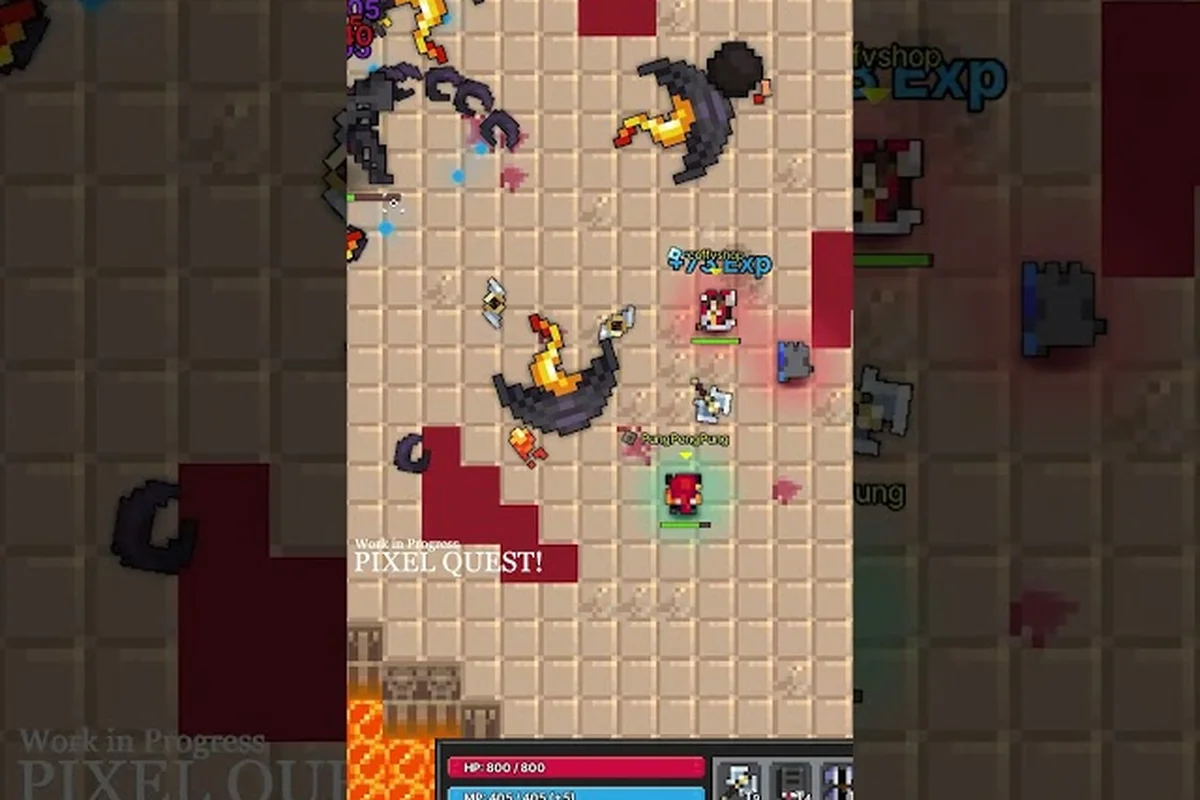
Pixel Quest throws you into a 2D open world where bullet hell combat and roguelike permadeath collide, and the learning curve can feel brutal for newcomers. This Pixel Quest bullet hell guide breaks down the two skills that decide whether you survive your first hour: reading projectile patterns and choosing a starting class that matches your reflexes. Since the game wipes your character on death, understanding these fundamentals before you commit matters more than any gear you might loot.
The core loop is deceptively simple — shoot, dodge, loot, level up — but the difficulty ramps quickly once you step into your first dungeon. According to the official Pixel Quest page on Roblox, the game features 80+ bosses and 30+ dungeons, which means you will face dense bullet patterns far earlier than you expect. Your class choice and your ability to read incoming fire determine how far you get, so let's start with the movement fundamentals that keep you alive.
Mastering Movement: The Foundation of Bullet Hell Survival
Every death in Pixel Quest traces back to a positioning mistake, not a damage problem. The game rewards players who treat movement as their primary defensive tool, because your character's hitbox is small but the screen fills with projectiles quickly. Learning to move deliberately — rather than panicking — is the single biggest skill gap between players who clear dungeons and those who lose characters in the first biome.
Your movement options are straightforward: eight-directional walking, a dodge roll on a short cooldown, and the ability to weave between gaps in bullet patterns. The dodge roll grants brief invincibility frames, but spamming it leaves you vulnerable when the cooldown resets mid-pattern. Veteran players recommend reserving your roll for telegraphed burst attacks rather than using it to navigate dense fields, because walking through gaps conserves your escape tool for when a boss locks onto your position.
Reading Projectile Patterns Before They Reach You
The key to dodging projectiles in Pixel Quest is recognizing that every enemy telegraphs its attacks with a wind-up animation. Bosses flash, charge, or change color before firing, giving you roughly half a second to reposition. New players who focus on their own character miss these cues entirely, which is why the game feels unfair until you train your eyes to watch enemies instead of your health bar.
| Pattern Type | Visual Cue | Safe Zone | Common Mistake |
|---|---|---|---|
| Radial burst | Enemy flashes white | Stand between bullets | Dodging backward into the ring |
| Aimed spread | Enemy faces your direction | Strafe perpendicular | Running in a straight line |
| Wall of bullets | Screen-edge glow | Find the gap early | Waiting until bullets arrive |
| Homing orbs | Pink trail behind orb | Circle around the source | Outrunning instead of orbiting |
Each pattern demands a different response, and the table above summarizes what experienced players watch for. Radial bursts require you to identify the gaps before the ring expands, while aimed spreads punish players who move in predictable straight lines. The homing orb mechanic is where most beginners die, because their instinct to sprint away actually makes the chase last longer — circling tightly around the orb's origin point causes it to lose tracking.
Positioning Rules That Apply to Every Fight
Beyond pattern recognition, your positioning relative to the enemy matters just as much as your reaction speed. Staying near the bottom of the screen gives you maximum reaction time, because projectiles travel downward and you can see them coming from farther away. However, some bosses fire patterns that bounce off walls or sweep upward, which means you need to adjust your anchor point based on the arena layout.
-
Maintain a mid-range distance — close enough to land consistent damage, far enough to see the full pattern develop
-
Keep an escape lane open — never corner yourself against a wall or obstacle, because your dodge roll cannot phase through terrain
-
Move in small circles — large sweeping movements trigger aimed attacks more often, while subtle repositioning keeps you under the enemy's targeting threshold
-
Use the environment — pillars and rocks block line-of-sight for some enemy types, giving you brief breathing room to heal
These positioning rules apply across every biome and boss encounter, which is why they form the backbone of any Pixel Quest early game guide. Once you internalize them, you will notice your death count dropping even before you upgrade your gear.
Choosing Your Starting Class for Maximum Survivability
| Statistic | Value | Details |
|---|---|---|
| Visits | 23.7M+ | Total visits on the Roblox game page |
| Favorites | 338K+ | Total favorites on the Roblox game page |
| Bosses | 80+ | Total unique bosses available in the game |
| Dungeons | 30+ | Total dungeons available to clear |
| Update cadence | Weekly | ALPHA release updates every weekend |
| Engine | Forge2D | Custom framework built by developer coffvshop |
Your class choice determines your base stats, your starting weapon, and your survivability curve through the first few hours. While every class can clear content with enough skill, some are far more forgiving for players who are still learning how to dodge projectiles. The game currently offers four base classes, each with distinct strengths and weaknesses that shape your early game experience.
| Class | Base HP | Starting Weapon | Difficulty | Best For |
|---|---|---|---|---|
| Swordsman | 120 | Iron Sword | Easy | Learning melee spacing |
| Archer | 90 | Short Bow | Medium | Safe ranged damage |
| Mage | 75 | Apprentice Staff | Hard | Burst damage fans |
| Rogue | 85 | Bronze Dagger | Hard | High-risk mobility |
The Swordsman is widely considered the best starting class for beginners because its high HP pool forgives positioning mistakes that would kill other classes. Melee combat in Pixel Quest requires you to stay close to enemies, which sounds dangerous in a bullet hell game, but the Swordsman's health buffer gives you time to learn enemy patterns without instant punishment. Your sword also has a wide swing arc that hits multiple projectiles, destroying them before they reach you.
The Archer offers the safest learning experience because you can engage enemies from off-screen range, reducing the density of bullets you need to dodge. However, the lower HP pool means that when you do get hit, the damage feels significant. Players who choose the Archer need to commit to the positioning rules from the previous section, because you cannot trade hits the way a Swordsman can. If you want a detailed breakdown of how each class scales into the mid-game, the class stats overview covers stat allocation and build priorities in depth.
Why the Swordsman Wins for New Players
The Swordsman's kit revolves around melee range combat with a health pool that starts at 120 — roughly 60% higher than the Mage. This buffer transforms the learning experience, because you can afford to take two or three hits while you figure out a boss's attack rhythm. The starting Iron Sword also has a generous hitbox that cleaves through incoming projectiles, effectively giving you a melee shield that destroys bullets on contact.
Your melee attacks also interrupt enemy wind-ups, which means you can cancel dangerous telegraphed attacks before they fire. This aggressive playstyle shortens fights significantly, reducing the number of bullet patterns you need to survive. The trade-off is that you must close distance through open fire, which requires you to weave between projectiles rather than avoiding them entirely. For players who want a full breakdown of melee builds, the starting class guide compares the Swordsman against other options across solo and co-op scenarios.
When to Pick the Archer or Mage Instead
The Archer becomes the better choice if you struggle with the mental load of tracking both your position and the enemy's melee range simultaneously. Ranged combat lets you focus purely on dodging, because your attack animation does not require you to reposition. The Short Bow fires quickly and its arrows travel in a straight line, making it easy to land consistent damage while you focus on survival.
The Mage offers the highest damage potential but demands the most from your movement skills. Your Apprentice Staff fires slow projectiles that arc slightly, and your low HP pool means every mistake costs you a significant chunk of health. Players who choose the Mage should expect to die several times before the class clicks. If you prefer a class that rewards careful positioning over raw reflexes, the class guide breaks down the strengths of each option in more detail.
Early Game Priorities: What to Do in Your First Hour
Your first hour in Pixel Quest sets the tone for your entire run, because permadeath means every decision carries weight. The game's official description emphasizes exploration, loot collection, and questing, but new players often waste time on activities that offer poor returns. Prioritizing the right tasks keeps your character alive longer and accelerates your progression toward the first dungeon.
The most important early goal is reaching level 5 before attempting any dungeon content. Each level grants stat points that increase your damage and survivability, and the difference between level 3 and level 5 is substantial. Focus on completing the starter quests in the first biome, because they reward experience points and basic gear that carry you through the opening hours. Avoid wandering into higher-level zones, because enemies there deal damage that outpaces your health pool.
Your First-Hour Checklist
-
Complete the tutorial quests to unlock your class abilities and basic consumables
-
Farm the first biome's easy enemies until you reach level 5
-
Bank any Valor Tokens you earn at the hub — these persist after death
-
Equip the best gear you find, even if it means replacing your starting weapon
-
Study the first dungeon's entrance before committing to a run
The Valor Token banking system deserves special attention, because it is the only progression that survives death. When your character dies, you lose your gear, your levels, and your quest progress — but Valor Tokens stay in your account. Spending them on permanent upgrades and cosmetics gives your next run a head start, which is why experienced players bank tokens early rather than hoarding them. The what-to-do-first guide covers this priority system in more detail, including how permadeath mechanics shape your decision-making.
Understanding the Permadeath Risk
Permadeath means your character is gone forever when you die, which creates a tension that defines the Pixel Quest experience. This mechanic is borrowed from classic roguelike games, and it forces you to evaluate every risk against its potential reward. Entering a dungeon at level 3 with starter gear is a gamble that often ends in death, while waiting until level 5 with upgraded equipment dramatically improves your odds.
The game softens this punishment through the Valor Token system, which rewards you even when you die. Every enemy you defeat and every chest you open grants tokens that persist across runs, so your time is never truly wasted. This design encourages aggressive play while still punishing reckless decisions, creating a balance that keeps players engaged. Understanding this risk-reward loop is essential for anyone following this Pixel Quest bullet hell guide, because it changes how you approach every encounter.
Practical Dodge Training: Drills That Build Muscle Memory
Reading about dodging is one thing, but building the muscle memory requires deliberate practice. The good news is that Pixel Quest's early biomes offer safe environments to train your reflexes without risking your character. Spending ten minutes on focused drills saves you hours of lost progress from avoidable deaths.
The first biome's open fields are ideal for practicing pattern recognition, because the enemies there fire slow, telegraphed projectiles. Instead of killing everything as fast as possible, spend a few minutes deliberately dodging attacks without firing back. This forces you to focus purely on movement, building the visual habits you need for denser encounters later.
Three Drills to Run Before Your First Dungeon
Drill 1: The Gap Finder — Find a group of three or more ranged enemies and position yourself between them. Let them fire at you while you practice weaving through the gaps without using your dodge roll. The goal is to survive for 30 seconds without taking a hit, using only movement. This trains your eyes to spot safe paths through overlapping patterns.
Drill 2: The Roll Discipline — Fight a single enemy while restricting yourself to one dodge roll per 10 seconds. This forces you to use the roll only for emergencies, building the discipline to save it for telegraphed burst attacks. Players who master this drill stop panic-rolling into worse positions.
Drill 3: The Orbit Exercise — Find an enemy that fires homing projectiles and practice circling around it at close range. The goal is to keep the orbs chasing you in a tight loop without letting them connect. This drill builds the spatial awareness needed for the game's most dangerous enemy type.
Each drill takes about five minutes, and running all three before your first dungeon attempt dramatically improves your survival odds. The homing orb mechanic in particular trips up most beginners, so the third drill is worth repeating until it feels natural.
Common Mistakes That End Runs Early
Every Pixel Quest player has a graveyard of characters lost to preventable mistakes, and recognizing these patterns in your own play is the fastest way to improve. The most common errors stem from treating the game like a traditional RPG rather than a bullet hell experience, which leads to positioning decisions that invite death.
Overcommitting to damage is the deadliest habit new players develop. When a boss enters its enrage phase and fills the screen with projectiles, the correct response is to stop attacking and focus purely on survival. Beginners keep firing because they want to end the fight quickly, but the extra damage rarely outweighs the cost of taking avoidable hits.
The Four Deadly Habits
-
Tunnel vision on your character — you miss enemy telegraphs because you are watching your own sprite instead of the threats around you
-
Cornering yourself — backing into walls and obstacles removes your escape routes when patterns get dense
-
Ignoring Valor Token banking — dying with unspent tokens wastes the only progression that carries over
-
Rushing into dungeons underleveled — the first dungeon assumes you are around level 5, and entering earlier is a coin flip
Breaking these habits requires conscious effort, because they are natural responses to stressful situations. The tunnel vision problem is the hardest to overcome, since your instinct is to track your own character's position. Training your eyes to watch enemy wind-ups instead rewires how you process the screen, and the drills in the previous section are designed specifically to build this habit.
Frequently Asked Questions
What is the best starting class in Pixel Quest?
The Swordsman is the best starting class for beginners because its 120 base HP forgives positioning mistakes that kill other classes. The wide sword swing also destroys incoming projectiles, giving you a melee shield while you learn enemy patterns. Archer is a solid alternative if you prefer ranged safety.
How do I dodge projectiles effectively in Pixel Quest?
Focus on watching enemy wind-up animations rather than your own character, because every attack telegraphs before firing. Maintain mid-range distance, keep an escape lane open, and reserve your dodge roll for telegraphed burst attacks. Walking through gaps in bullet patterns conserves your roll for emergencies.
What carries over after death in Pixel Quest?
Valor Tokens persist after death, along with any cosmetics or permanent upgrades you purchased with them. Your character's level, gear, and quest progress are lost permanently. This is why banking tokens early is critical — they give your next run a head start.
How long does it take to reach the first dungeon?
Most players reach the first dungeon in about 30 to 45 minutes if they focus on completing starter quests and farming the first biome to level 5. Rushing this process often leads to death inside the dungeon, so patience is the better strategy.
Can I change my class after starting?
No, your class is locked when you create your character, and death sends you back to the character creation screen. This means your class choice is permanent for that run, so choose based on your preferred playstyle rather than what seems strongest in the meta.